
SEO reports should tell you which actions will grow your business rather than just show you charts and numbers that look impressive.
In reality, you get charts presenting keyword rankings going up and down, and organic traffic numbers. But nobody actually tells you if those visitors are buying anything or filling out your contact forms.
Here, search engine optimization reporting should go further to connect those numbers to real outcomes, like enquiries, sales, and revenue. Because a dropped ranking only counts if it affects conversions.
This guide breaks down how to read ranking reports the way SEO agencies do. So that you can learn which SEO metrics actually predict success, how to spot real progress in Google Analytics, and which numbers you can safely ignore.
By the end, you’ll know exactly what to look for in your monthly SEO reporting. Let’s get started.
How to Read SEO Reports Without Getting Overwhelmed
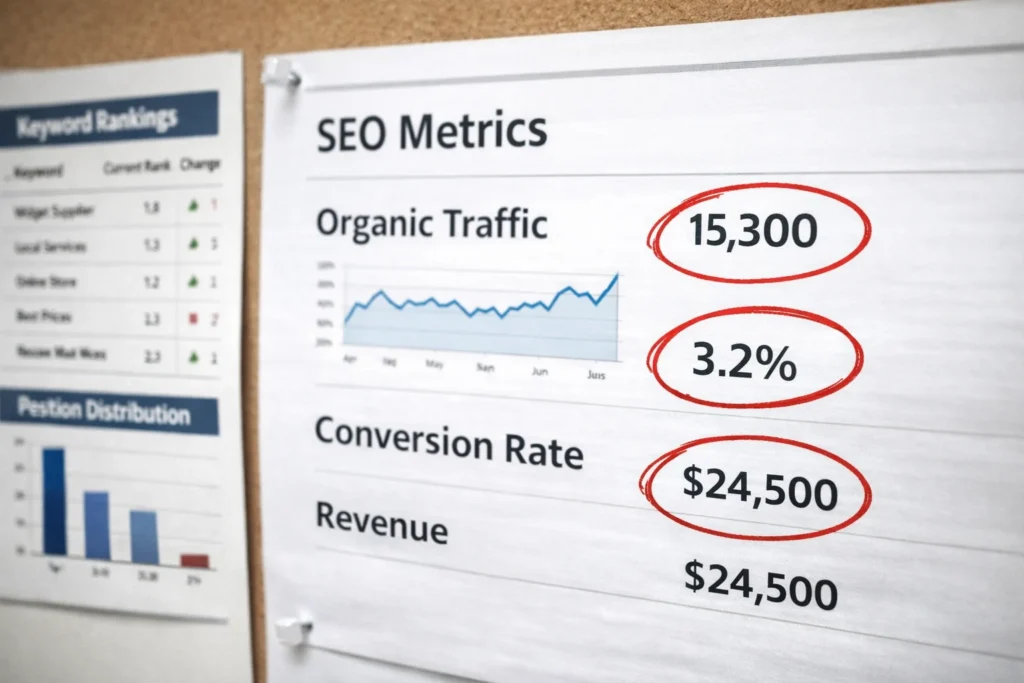
You can start reading by identifying the three to five metrics directly connected to your business goals, then ignore everything else.
Most SEO dashboard tools dump 50 data points in your lap. It’s because raw data about search rankings, bounce rate, and visibility score all compete for your attention.
However, you can follow the approach below to read your SEO reports:
Start With These Core SEO Metrics That Are Truly Significant
Firstly, focus on organic traffic, conversion rates, and revenue before checking individual keyword rankings. Because your reporting tool might show you’re ranking for 500 keywords. But if organic conversions are flat, those rankings aren’t doing anything useful.
Then you can look for month-over-month trends instead of daily fluctuations. After all, one day you’re in position 3, the next day you’re in position 5, and this happens constantly with search engines.
Pro tip: Compare your performance against your own baseline, not competitors you can’t directly control.
Ignore Vanity Numbers That Look Good But Mean Nothing
Sometimes, total impressions sound impressive but mean nothing if nobody clicks through to your site. For instance, a reporting tool might show 50,000 impressions last month. But with a 0.5% click-through rate, you’re only getting 250 visits.
Besides, domain authority scores from third-party SEO tools don’t reflect what search engines think of you (and yes, those scores change daily for no real reason).
Ranking for hundreds of target keywords is also pointless if none bring qualified traffic. We’ve seen clients celebrating 300 keyword rankings while their leads stayed flat.
Reading Keyword Rankings the Right Way
The best part about understanding ranking reports is learning which position changes deserve your attention and which ones don’t.
Your keyword ranking report comes in every week. You see movement everywhere. But most of those shifts mean nothing for your bottom line.
Now, let’s look at what tells you whether a change is important:
Track Organic Traffic Trends Alongside Ranking Reports
You might be wondering why a ranking drop could increase traffic. Well, it happens when search volume for your keywords spikes enough to offset the position loss.
To be more specific, a drop from position 2 to 4 might still increase traffic only if search volume doubled. That’s why track keyword rankings alongside the organic search traffic they bring in.
In this case, keyword ranking tools show positions, but your search console shows clicks. So, you need both to see the full picture.
Generally, seasonal businesses see natural traffic swings unrelated to your SEO efforts. For example, if you sell air conditioners in Brisbane, your organic traffic will drop in winter even with strong search rankings. It means specific keywords perform differently depending on the month.
Brisbane search patterns often peak during different months than the national averages, which is why we recommend tracking organic traffic by location to spot these trends.
Landing Pages’ Performance Tells the Real Story
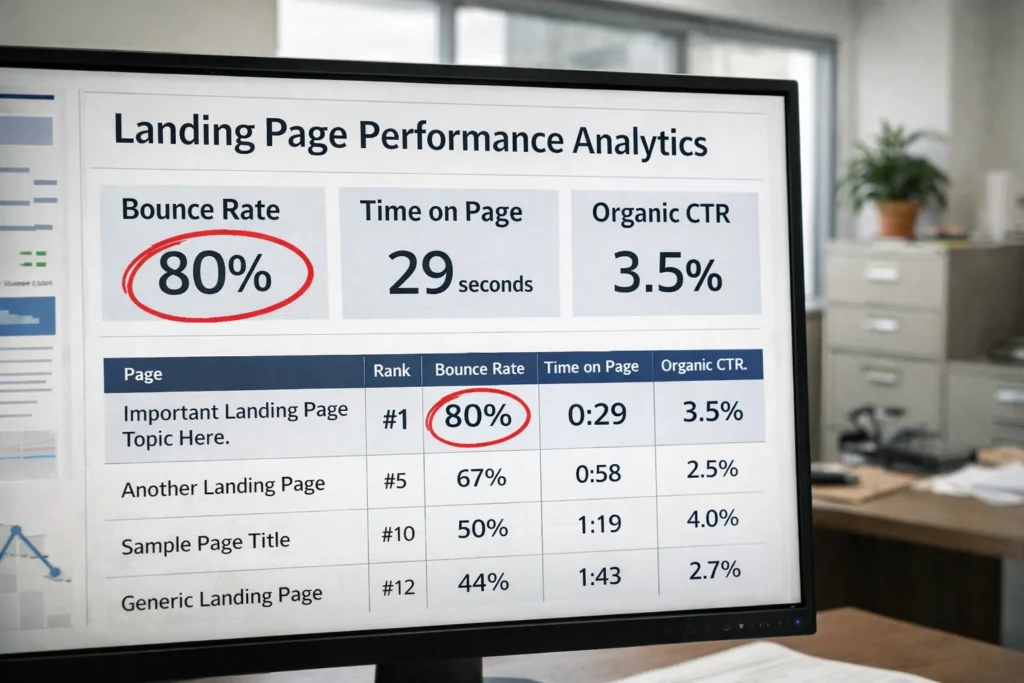
Check bounce rate and time on page to see if rankings deliver engaged visitors. It’s because a page ranking position 1 with an 80% bounce rate is wasting your budget.
Drawing from our work with Brisbane clients, we’ve seen pages ranking well but converting poorly. This indicates they need content fixes, not more backlinks.
One client ranked third for “digital marketing Brisbane” but had a 5-second average session time because the landing pages didn’t match search queries. When such issues occur, user behaviour metrics reveal whether your web pages match what searchers expected to find.
Remember, a low average position with high engagement beats a high ranking with a terrible bounce rate every time. So, track organic CTR alongside rankings to see which keywords bring visitors who stick around.
Spotting Real Progress in Google Analytics
What if you could filter out all the misleading SEO metrics and focus only on relevant data showing genuine business growth?
Well, it’s possible because most SEO reporting dumps every number Google Analytics tracks, including page views, sessions, users, and bounce rate.
Here, the trick is knowing what moves the needle for your business.
Track Organic Conversions to Measure True SEO Strategy Success
Frankly, traffic without conversions is just numbers on a screen. That’s why set up goal tracking for form fills, phone calls, and purchases before judging results.
On top of that, your Google Analytics should show you exactly which organic conversions came from SEO efforts versus Google Ads or other channels.
Compare organic conversion rates against paid ads to see your real cost per lead. If paid ads convert at 3% and organic search converts at 2%, you need that insight to guide your budget decisions. Plus, track organic conversions by keyword strategy to see which target audience segments respond best.
One Brisbane accounting firm we worked with celebrated 10,000 monthly visitors. But their organic conversions were only 15 enquiries, and the conversion rate was 0.15%. Then, we shifted focus from traffic growth to conversion optimisation. Six months later, they had 7,000 visitors with 45 enquiries (less traffic, triple the leads).
Reading Local SEO Performance in Search Results Data
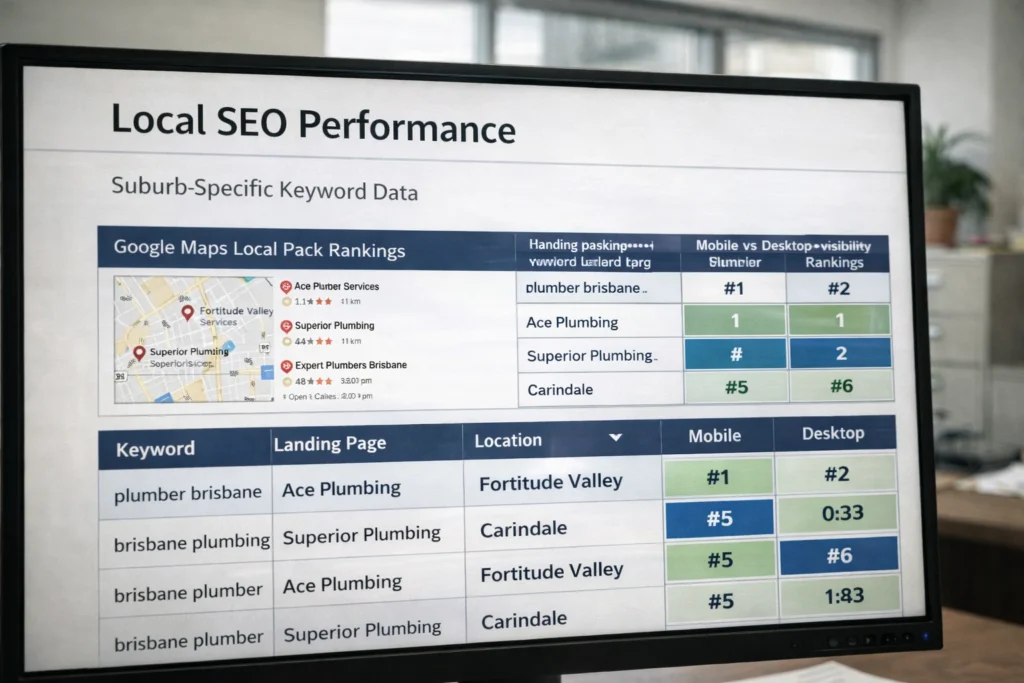
Local SEO rankings and Google Maps visibility drive more business than general organic positions. In that context, a Brisbane plumber ranking fifth nationally means nothing if they’re not in the local pack for “plumber Fortitude Valley.”
Always check suburb-specific keyword performance separately since “Fortitude Valley” searches differ from “Carindale” patterns (it’s a gap most local businesses completely miss).
For your information, your search console and Google Search Console data show performance by location, and Google search results vary wildly between suburbs only a few kilometres apart.
Recently, mobile-first indexing changed how Google evaluates sites. As a result, desktop search and mobile performance tell totally different stories for local searches. Don’t forget to check both in your SEO reporting.
Multiple pages competing for the same local keywords can also hurt your search visibility. For this reason, track which landing pages Google prefers for each suburb.
Separating Signal from Noise in Your SEO Reporting
Every SEO reporting dashboard contains dozens of data points, but only a handful indicate whether your campaign is working.
Believe it or not, most ranking fluctuations are just noise. Your rank tracker shows daily changes. Your ranking reports come in weekly. And you’re probably stressing over movements you can’t control.
Here’s what deserves your attention versus what you can safely ignore:
- Algorithm Updates: These cause temporary shifts in keyword rankings that usually stabilise within two to three weeks. Google tweaks search engine rankings constantly. So many ranking factors change during updates that individual position movements mean little.
- Single Keyword Drops: Through our practical experience managing campaigns, one keyword dropping doesn’t indicate trouble if your overall organic traffic stays stable (we’ve all panicked over a sudden drop before). One client lost their top spot, but their total organic search traffic increased 15%.
- Competitor Movements: They create short-term position changes but don’t reflect your site’s long-term quality. For instance, a competitor might build 50 referring domains or boost their backlink profile in a short burst. In response, your search engine results page’s position can drop temporarily, even if its bounce rate and Core Web Vitals are worse.
- Three-Month Patterns: Look for consistent trends over quarters rather than reacting to every weekly ranking report. Once that’s established, you can start making smarter decisions. Our tests revealed that tracking SEO KPIs over longer periods shows real trends better than daily rank tracking.
- Technical Errors vs. Ranking Shifts: Broken links and Core Web Vitals problems deserve immediate attention, while small search ranking changes can wait. For example, if your blog post drops from position 3 to 5, relax. But if the search console shows 404 errors, fix them instantly. Also, don’t forget that link building takes months to show results.
- Revenue from Organic Search: This is the ultimate SEO success measure, which cuts through all the confusion. Sometimes, multiple clients with excellent ranking reports may still fail when organic conversions drop. That’s why track how your SEO reporting connects to actual sales, not just search visibility.
Bottom line: Focus on SEO metrics that are tied to revenue, and ignore the rest of the noise.
Build Your Marketing Strategy on Reliable Data
Good SEO reporting doesn’t just stop after showing you numbers. Instead, it shows you where to put your SEO efforts next month. When your ranking reports connect organic traffic to actual revenue, you stop guessing and start growing.
The difference between useful and useless SEO metrics lies in one question: Does this number help me make money? Because if your SEO strategy isn’t tied to conversions, you’re only collecting data for the sake of having it.
Stop settling for ranking reports full of vanity metrics and confusing charts. At Motifo, we believe SEO reporting should guide your marketing strategy, not confuse it.
Want reports showing what’s working and what needs fixing? Get in touch with our Brisbane team and see how proper keyword research and SEO tracking can grow your business.