
You just got your monthly SEO report, and it’s packed. Ten blog posts published, twenty links built, a technical audit completed. Yet your traffic and rankings look exactly the same as they did three months ago.
That’s because getting more work done doesn’t automatically mean getting better results. But most business owners assume a busy report means a successful SEO campaign. Activity is the work your SEO team does each month. Progress is what that work changes for your rankings, traffic, leads, and revenue.
This article breaks down the difference between SEO activity and SEO progress, what each one means, and how to tell them apart in your own reports. You’ll also get a short list of questions to bring to your next SEO review.
Let’s get started.
Why Your SEO Reports Feel Busy but Show No Results
Most SEO reports lean on tasks completed instead of outcomes achieved, which is why they can feel busy without showing much movement. Fifteen new blog posts sound impressive, but if none of them ranks or attract visitors, they haven’t delivered a result yet.
The same applies to link building campaigns, technical fixes, and other SEO activities. They create the conditions for growth, but they don’t guarantee it.
This gap catches many business owners off guard. You’re paying for consistent work, and it’s happening. What’s missing is a clear line between the work itself and the results that work is supposed to produce. Once you can see that line, reading your own reports gets a lot easier.
SEO Activity: The Work Being Done
As we mentioned, SEO activity is everything your team does each month to improve how your site performs in search engines. It usually falls into three main areas, which we’ll cover below.
Content Creation and Optimisation
Content creation and optimisation means writing new pages, updating existing ones, and making sure each piece matches what your target keywords promise. This includes publishing blog posts, refreshing underperforming pages, and updating meta descriptions so Google search results reflect what each page covers.
These activities give search engines more content to crawl, index, and evaluate, but they rarely produce immediate results. New and updated pages need time to be discovered, assessed, and ranked. Until then, you’re unlikely to see meaningful movement in traffic or keyword positions.
Technical SEO Work
Technical SEO focuses on improving the parts of your website that help search engines crawl, understand, and index your pages. Common tasks include:
- Fixing crawl errors
- Repairing broken links
- Improving site speed
- Resolving mobile usability issues
These fixes aren’t optional. If search engines can’t read your site properly, none of your content or link-building efforts will perform the way they should. The impact of technical work also isn’t immediate. It shows up gradually as search engines re-crawl your site, process the changes, and update your rankings.
Authority and Link Building
Authority and link building focus on earning mentions and backlinks from other relevant websites across the web. Each link acts as a signal to search engines that your site is trustworthy and worth ranking. And over time, those signals accumulate to strengthen your backlink profile and improve how Google evaluates your site.
The challenge is that this work rarely shows up in rankings within the same reporting period it was completed. A link earned this month may not influence your search performance for several months. That makes it one of the harder SEO activities to evaluate, but it remains an important part of building long-term search visibility.
SEO Progress: The Results That Follow
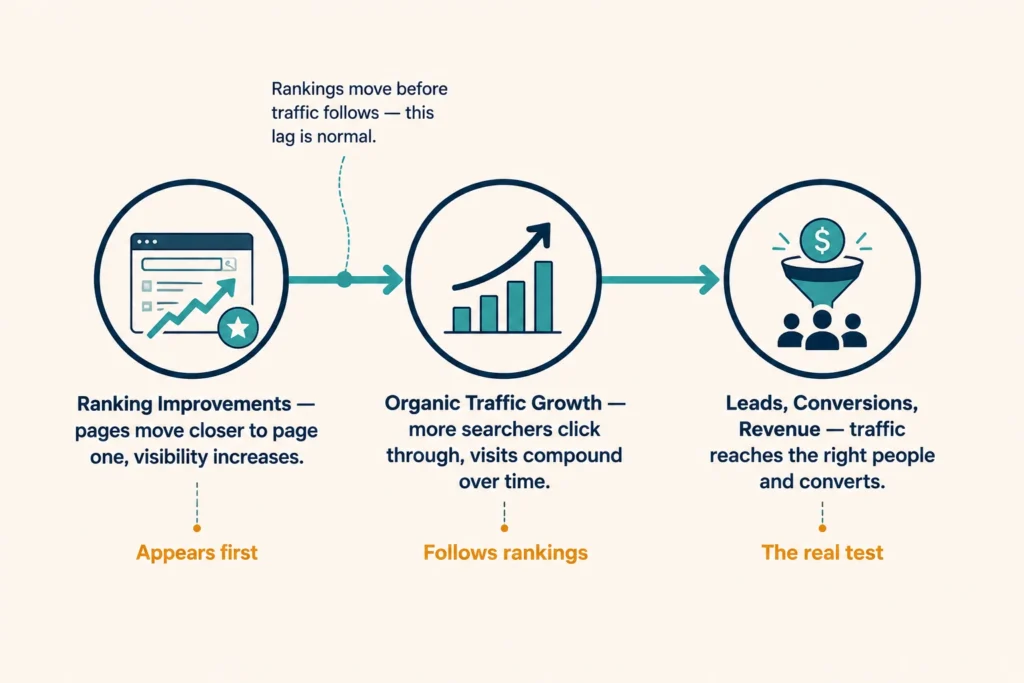
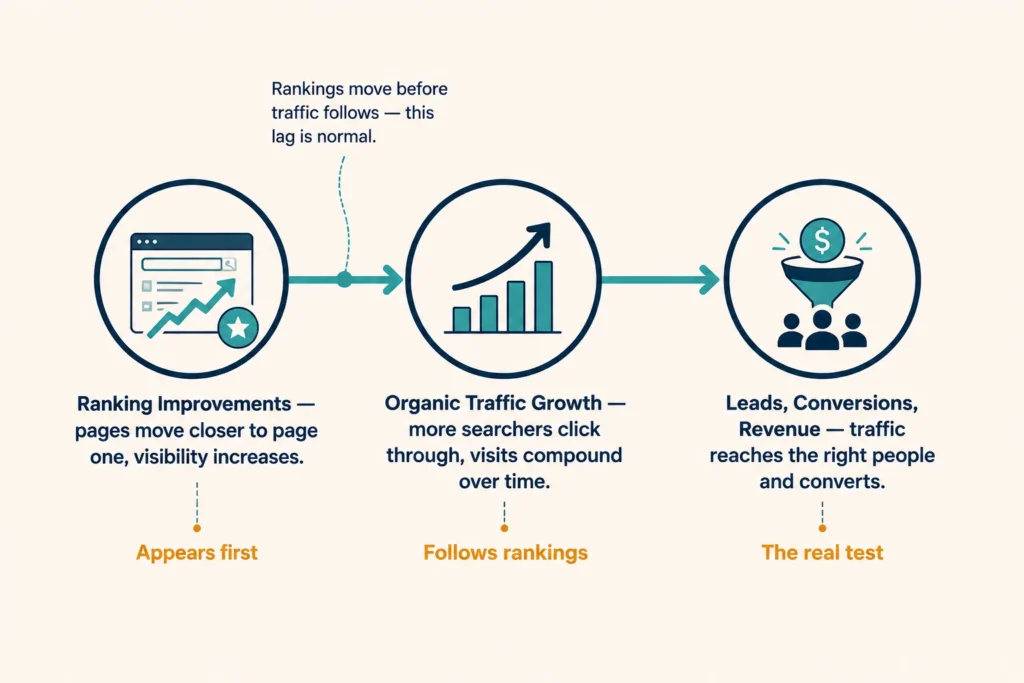
Once the work starts gaining traction, the results show up in a predictable order. Rankings move first, then organic traffic follows, and leads and conversions come after that. The following sections explain what each of these outcomes tells you.
Ranking Improvements
A ranking improvement means one of your pages has moved closer to the top of the search results for a keyword your audience is actively searching. Moving from position 15 to 6, for example, can significantly increase your visibility, even before traffic starts to rise.
Because rankings tend to improve before other SEO metrics, they’re often the earliest sign of genuine progress. Higher visibility creates more opportunities for clicks, which can later translate into traffic, leads, and conversions.
Organic Traffic Growth
Organic traffic growth happens when more people start finding your website through unpaid search results. As your pages become more visible for relevant searches, they attract a larger share of clicks and visitors.
And this growth compounds over time. Once a page ranks well, it can keep bringing in visitors for months or years without extra spend, which sets SEO apart from paid ads that stop the moment you stop paying.
You can check whether your rankings are driving visits by looking at click-through rates (CTR) in Google Search Console. A page sitting in position four with a low CTR usually points to a title or meta description that isn’t compelling enough to earn the click.
Leads, Conversions, and Revenue
Rankings and traffic only tell part of the story. The real test is whether that attention leads to business outcomes. A page can rank well and attract visitors. But if those visitors never contact you, request a quote, or make a purchase, there is still a gap between search performance and business results.
Closing that gap is what connects SEO activity to tangible business outcomes. An increase in enquiries, sales, bookings, or other valuable actions from organic visitors shows that your SEO efforts are reaching the right people.
Key Metrics for Measuring Your SEO Progress
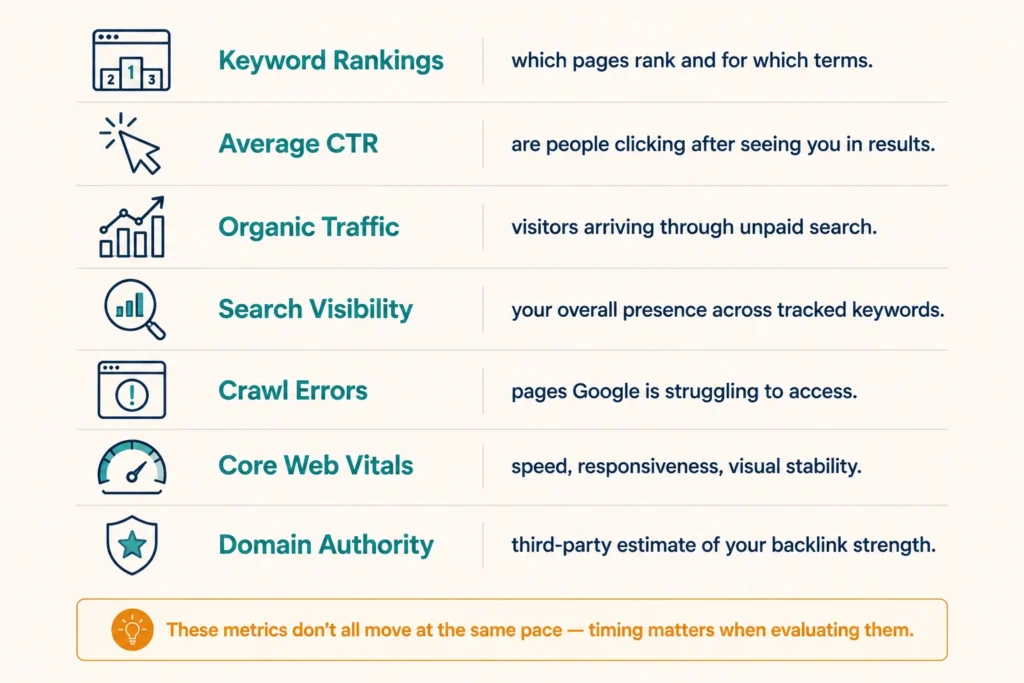
Tracking the right numbers is what separates a useful SEO report from one that just looks full. The metrics below help you determine whether your SEO activity is producing genuine progress or simply generating more tasks to report on.
| Metric | What It Tells You |
| Keyword rankings | Which pages are ranking and which search terms they rank for |
| Average CTR | Whether people are clicking your pages after seeing them in search results |
| Organic traffic | How many visitors are arriving through unpaid search |
| Search visibility | Your overall presence in search results across all tracked keywords |
| Crawl errors | Which pages Google is struggling to access or index |
| Core Web Vitals | How well your pages perform in terms of speed, responsiveness, and visual stability |
| Domain authority | A third-party estimate of your site’s authority based largely on its backlink profile |
These metrics won’t all move at the same pace. Some respond relatively quickly, while others can take months to show meaningful change, so it’s important to consider timing when evaluating SEO performance.
When Should Activity Lead to Progress?
For most websites, SEO activity starts producing visible ranking movement somewhere between months three and six. The exact timeline depends on your industry, how competitive your keywords are, and the current state of your website.
That said, there is a general pattern most campaigns follow.
Months 1–3
This is the foundation phase. Your team is publishing content, fixing technical issues, and building links, but search engines need time to crawl, process, and evaluate those changes. Visible ranking movement is minimal at this stage, and that’s completely normal.
Months 3–6
At this stage, SEO efforts start to surface. Pages targeting lower competition keywords begin to rank, search visibility improves, and you may start seeing small but consistent traffic increases. For Brisbane businesses we’ve worked with, this is usually the phase where confidence in the campaign starts to build.
Months 6
By now, progress should become easier to see. Rankings, traffic, and conversions should show clearer patterns, which gives you a better picture of whether your SEO efforts are producing results. If reports still focus only on completed tasks without measurable improvement, it’s worth asking your agency why.
Questions to Bring to Your Next SEO Report Review
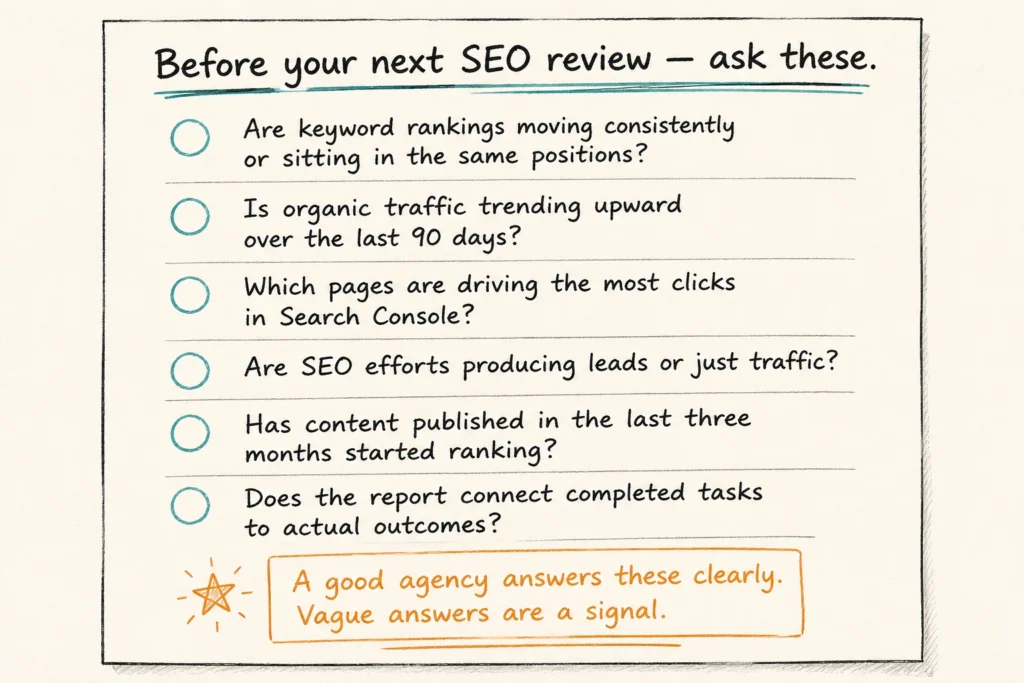
Your next SEO review is the right time to shift the conversation from what was done to what it produced. These questions help you do exactly that:
- Are my keyword rankings moving consistently, or are the same tracked keywords sitting in the same positions they were three months ago?
- Is organic traffic trending upward over the last 90 days, or am I only seeing short-term fluctuations?
- Which pages are driving the most clicks in Google Search Console, and are they the pages we’re targeting?
- Are my SEO efforts producing leads or enquiries, or just more traffic with no conversions?
- Has the content published in the last three months been indexed and started ranking for any new keywords?
- Is the SEO analysis in my reports tied to outcomes, or does it only describe completed tasks?
A good agency should be able to answer these questions with clear explanations and evidence. If the answers are vague or keep circling back to completed tasks, your reporting probably needs a reset.
Stop Counting Activity and Start Tracking Progress
Once you can tell activity apart from progress, your SEO reports become far easier to read and evaluate. You’ll know what to look for, which questions to ask, and whether the work being completed is moving your campaign forward.
At Motifo, we’d rather underpromise and overdeliver than throw around ranking guarantees no one can keep. We send monthly reports that connect completed work with the results it’s helping to create, so you always know where your campaign stands.
If your current reports leave you with more questions than answers, we’re happy to show you what we track and why. Get in touch with our team today.