How to Measure ‘Real’ SEO Success in 2026

Since AI Overviews now answer questions directly on Google’s results page, users are visiting individual sites much less. This is why you should measure real SEO success in 2026 by tracking AI visibility, branded searches, and conversions instead of rankings and traffic.

Here at Motifo, we help brands adapt to this change by focusing on what truly drives growth: AI citations and engagement quality. And since we know how to put these flexible digital marketing strategies into practice, we can help others gain clarity.

In this guide, we’ll cover:

  • What the great decoupling means for SEO
  • Why traditional metrics fail in 2026
  • Which new metrics actually drive growth
  • How to track AI visibility and brand mentions
  • The best tools for measuring AI-era performance

Ready to step into the new era of search with purpose? Let’s begin.

What Is the Great Decoupling in SEO?

What Is the Great Decoupling in SEO?

The great decoupling occurs when your search impressions increase while organic traffic decreases. It refers to an SEO shift in which people get what they need directly from AI-powered results instead of traditional search engine results.

Here’s a quick breakdown of exactly how that’s happening.

Impressions Surge, But Traffic Drops

According to a BrightEdge report titled “One Year Into Google AI Overviews”, search impressions have risen by more than 49% while click-throughs have declined nearly 30% since the launch of AI Overviews.

Here’s what that means in practice: Suppose your site pulled 100,000 impressions last year. Fast forward to today, and you’re sitting at 149,000. That’s nearly 50,000 more people seeing your content. Sounds amazing, right? Except now your clicks are also down by 30%.

So even with all that extra visibility, fewer people are actually visiting your site. It’s like having more window shoppers but fewer customers walking through the door.

AI Overviews Create Zero-Click Searches

Zero-click searches happen when people get the answer directly on the results page through AI-generated content, so they don’t need to visit any website.

Pew Research Center has found that if an AI-generated summary appears on a Google search results page, users end their browsing session 26% of the time. But if there’s no summary available, the number goes down to 16% (you get why your reports feel “off” now?).

Imagine someone searching “best time to post on Instagram”. They’ll likely read the AI answer at the top, and they’re done. Why would they visit your blog or scroll through your carefully crafted guide, when they can get what they came for without leaving Google?

Pro tip: Publish content in multiple formats, since AI tools sometimes cite PDFs, reports, and tables more often than blog posts.

Why Do Traditional SEO Metrics Fail in 2026?

Why Do Traditional SEO Metrics Fail in 2026?

Have you ever seen your rankings go up but your results feel worse, and thought, “What’s going on here?”

Well, you aren’t imagining it. Search keeps changing every day, and the old numbers can’t keep up anymore. Specifically, people now find brands in new ways, but the numbers you track still speak the language of traditional search.

Let’s get into more detail about the reasons why you aren’t getting the full picture.

Organic Traffic Ignores AI-Driven Visibility

The best thing about AI visibility is that it helps people remember your brand even when they don’t click.

Wait, but what about the traffic? Well, nowadays, traffic tells you one story, while brand awareness tells you another. That’s why you might see a 20% loss of your clicks, yet at the same time, your brand mentions in AI answers might jump by 40%.

That’s a huge difference, and it shows why the numbers on your dashboard don’t always tell the whole truth.

For instance, someone might ask ChatGPT about project management tools, and your product gets mentioned in the answer. The user doesn’t click through, but they’ll probably remember your name.

That’s brand recall, and your traffic reports miss it completely.

Keyword Rankings Miss Answer Engine Citations

High search rankings once meant consistent traffic, but it doesn’t anymore. Rather, if ChatGPT recommends three competitors when someone asks for “best email marketing software” and you’re not one of them, your high ranking won’t help you.

We’ve even seen Perplexity pulling citations from position 47. The old first-page rules you might trust in regular search don’t really work inside answer engines anymore (the game really did change!).

Now that you know why old metrics fail, let’s talk about the ones that are important right now.

What Metrics Are Important in 2026?

What Metrics Are Important in 2026?

Simply put, you need to track how often AI tools mention your brand and how many people search for you by name. You should also keep an eye on how real users engage with your content.

Focus on these main SEO metrics in 2026:

  • AI Visibility and LLM Citations: Wondering how often your brand appears when someone asks ChatGPT or Perplexity a question? That’s called AI visibility. More mentions mean more trust signals to both users and algorithms, which strengthens your overall organic growth strategy and increases brand recognition.
  • Branded Search Volume: You must look for how many people type your company name directly into Google each month. If that number’s climbing, your content strategy is working. Growing branded searches show you’re building actual demand.
  • Engagement Quality: Time on page, scroll depth, and repeat visits tell you if people actually read your content or bail after three seconds. High engagement means you’re keeping users interested instead of just luring them in with clickbait headlines.
  • Conversions and ROI: Honestly, a thousand visitors mean nothing if there’s zero conversion. So, you should track leads, sales, and revenue from organic search. Seriously, real business results beat vanity metrics.
  • Content Relevance Scores: AI scans your content and decides if it matches what people want. Better alignment with common queries means higher scores, which means AI is more likely to cite you as a credible source worth recommending.
  • E-E-A-T Authority: When Forbes links to you or industry experts write for you, AI notices. Nearly half of all SEO professionals (49%) are pouring money into authority building because it’s the one thing AI can’t fake or replicate.
  • Bot Activity: Check your server logs. Are ChatGPT’s bots and Google’s AI crawlers visiting regularly? More crawls today usually mean better AI citations tomorrow. It’s like getting a preview of where your visibility is headed.

These numbers are your best chance at staying sane in a world where search keeps changing.

How Do You Track AI-Era SEO Metrics?

organic growth analysis

You can track AI-focused SEO metrics using tools like Semrush AI Tracker and Brand24. Since Google Search Console and GA4 can’t provide insights into AI-generated content or brand mentions, these tools are important for gaining a complete view of your SEO performance.

It’s time to dig deeper into these options for tracking metrics.

Tools for Monitoring AI Visibility

The right AI SEO tools show exactly where you appear across answer engines. For one, Semrush AI Tracker monitors your presence across multiple platforms in one dashboard. You can see how often you show up in AI Overviews, which queries trigger your content, and how your visibility compares to competitors.

Brand24 is another tool that tracks brand mentions inside AI-generated responses. It scans ChatGPT, Perplexity, and other answer engines to catch every time your company gets referenced (yes, you can track your influence even without page views).

These tools replace traditional ranking trackers because visibility in AI is more valuable than position number three on Google.

Pro tip: Check for outdated facts on pages that attract AI citations. If AI catches an old stat or definition, it may drop the whole page.

Measuring Brand Mentions Across LLMs

Brand mention tracking requires both manual prompt testing and automated monitoring software combined. You need to start the process by testing prompts yourself. Open ChatGPT and ask questions your customers would ask. Do you show up in the answers? Do your competitors?

The results will give you a baseline understanding of where you stand.

Then use Knowatoa to automate the process. It monitors citations across answer engines without you needing to manually check daily. You’ll also want to track which conversational queries trigger your brand most often because that tells you what’s working.

Tracking Engagement Quality in Google Analytics 4 (GA4)

Google Analytics 4‘s engagement metrics finally reveal whether your content satisfies actual user intent properly. Just set up scroll depth tracking first, which will show how far people scroll before leaving. If everyone bounces at 20%, your intro needs work.

Also, don’t forget to monitor average session duration and pages per session next. These numbers tell you about content quality. Finally, track repeat visitors to understand if people found your site valuable enough to come back later.

Tracking SEO Success in an AI-First World

The brands winning in AI search are building authority, earning citations, and showing up where their customers actually look for answers. And the metrics that worked in 2023 have become obsolete. Impressions are up, clicks are down, and traditional rankings tell you nothing about AI citations.

If you need help adapting your SEO strategy, contact us today. We’ll help you with tracking actual visibility and business results in 2026.


Why SEO Results Take Time and What Happens in the First 90 Days

Search engines need time to understand changes to a website, like content updates, technical improvements, and new links. That’s why SEO doesn’t deliver results overnight.

Most companies see early movement within 3 to 6 months, with stronger growth afterwards between 6 and 12 months. At Motifo, we’ve guided Brisbane businesses through this process for years. We know what realistic progress looks like and what to expect at each stage.

In this article, we’ll cover why SEO takes time and what happens in the first 90 days. You’ll also learn how to measure progress before rankings change.

Ready? Let’s begin.

Why Do SEO Results Take So Long?

Three SEO professionals are reviewing website performance and SEO timeline visuals on a desk in a naturally lit office.

SEO results take time because search engines need to crawl, index, and evaluate your pages before deciding where to rank them. Google also tests new content by moving rankings up and down for weeks before positions stabilise.

Here are the things that happen before search engines rank your site:

  • Crawling and Indexing: You might publish a blog post today, but it could sit unnoticed for days or even weeks. It’s because Google discovers pages on its own schedule. But bigger websites with regular updates get crawled more often, so if your site is newer, expect to wait a bit longer.
  • Trust and Authority: Building credibility with Google takes time (and there’s no shortcut). However, a strong backlink profile helps because it shows other websites vouch for your content. We’ve worked with new domains that took 6 months or more to rank, even with great content already live.
  • Ranking Fluctuations: Your page might hit position 15 one day and drop to 40 the next. It happens due to Google’s continuous testing. This back and forth usually lasts 60 to 90 days while the algorithm figures out how users respond to your content. Things tend to settle after that period.
  • The Google Sandbox: New websites often struggle to rank for the first few months, even when everything looks right. Google has never confirmed a so-called sandbox, but many site owners have experienced this delay. So the best approach here is to keep building quality content and earning links while you wait it out.

When these checks are complete, search engines have enough data to rank you.

What Happens in the First 90 Days of SEO?

A man and a woman are planning an SEO strategy at a desk, with a visual timeline board in the background representing the first 90 days of SEO work.

The first 90 days of SEO focus on building a solid foundation. It includes technical audits, keyword research, on-page fixes, and early content creation. You won’t see major ranking improvements yet, but this preparation sets up major things that come next.

We’ll explain what happens during the first three months below.

Days 1 to 30: Discovery and Technical Foundation

The first month usually covers research, technical SEO audits, and setting up tracking tools. Everything kicks off with a website audit. The goal here is to catch technical issues like broken links, crawl errors, or painfully slow load times. Keyword research runs alongside this process and finds terms you can realistically rank for.

Not only that, but core SEO tools like Google Search Console and Google Analytics get set up during this stage, too. They allow you to see how Google views your site and identify technical issues before they limit your visibility.

Days 31 to 60: On-Page Optimisation and Content Planning

The biggest benefit of getting on-page elements right is that it helps search engines understand your pages faster. These elements include meta tags, headers, and internal links.

At the same time, your content plan takes shape by using the research from the first month to decide what to create or improve next. Most teams tackle Core Web Vitals around now as well. Things like load speed, visual stability, and interactivity all factor into rankings.

When you handle these things properly, they improve the experience for users and make your site easier for Google to understand.

Pro tip: Use internal links to point from high-traffic pages to newer ones to help Google discover and value them faster.

Days 61 to 90: Content Publishing and Early Signals

By around day 90, some businesses begin to see long-tail keywords appear in the top 50. Around the same time, your content starts going live, like blog posts, landing pages, or updated service pages (depending on your plan).

And you should focus on being consistent here with your content rather than publishing everything at once.

Then there’s link building. This strategy includes guest posts, local citations, and outreach to industry sites. It moves slowly at first, but the effects build over time. And when it’s happening, long-tail keywords often improve in rankings before competitive ones. It’s a clear sign things are heading in the right direction.

What Factors Speed Up or Slow Down Your SEO Timeline?

Three SEO professionals in colourful semi-formal attire are discussing website in a modern office,.

Your website’s starting point, backlink profile, and technical health play a role in SEO. There are also other factors like content quality, competition, keyword difficulty, and consistency.

While not everything is in your control, you can improve some of these elements with the right approach.

Let’s go through how these factors impact your SEO:

  • Website Starting Point: Older domains with clean histories typically rank faster because they’ve already built some trust with Google. But new sites need time to prove themselves. If you’ve got existing content and decent traffic, you’re starting ahead of someone who’s building from scratch.
  • Backlink Profile: If you can get quality links from trusted sites, they can seriously speed up your SEO timeline. But weak or spammy links hold you back. We’ve seen clients stuck in limbo for months because of dodgy links from years ago. Remember that link building takes consistent effort, and there’s no way around that.
  • Technical SEO Health: You can lose time to crawl errors, slow load speeds, and mobile issues, which in turn delay indexing and rankings. On the other hand, when your site runs smoothly, search engines tend to pick it up faster. For that reason, improving Core Web Vitals helps users and also sends positive signals to Google.
  • Content Quality: Helpful and original content tends to rank faster than thin pages filled with keywords. It’s because Google is now better at telling the difference. When your content clearly answers what people are searching for, results usually come sooner.
  • Market Competition: Honestly, some industries are tougher than others. So if you’re up against competitors with years of authority and thousands of backlinks, it’s going to take longer to rank. In comparison, local markets are usually easier. That’s why many businesses see results sooner than national brands targeting the same keywords.
  • Keyword Difficulty: When it comes to keywords, the hardest ones can take a year or more to rank for. So we recommend starting with easier, long-tail keywords to build momentum first. Meanwhile, you should keep working toward more competitive terms.
  • Resources and Consistency: If you have a smaller budget, things will move more slowly, and that’s normal. What causes bigger delays is stopping and starting. In reality, breaking momentum pushes results back much further than limited spend ever does.

These factors explain why SEO rewards those who prepare properly and stay patient.

How Do You Measure Progress Before Rankings Improve?

A man is going through early SEO performance indicators on dual screens. It represents how progress is measured before rankings improve.

You measure early SEO progress through leading indicators like indexed pages, crawl frequency, and impression growth in Google Search Console (GSC). These metrics show that Google is noticing your site, even when rankings haven’t moved yet.

How about we explain what indicators mean?

Leading Indicators to Watch

First, you need to check how many of your pages are indexed in Google Search Console. If that number is growing, Google is finding and storing your content. Then you should keep an eye on impressions. You might not be getting clicks yet, but more impressions mean your pages are showing up in search results.

Crawl frequency is another good sign. If Google is visiting your site more often, it means the algorithm sees activity worth checking. These numbers probably won’t impress your boss at a Monday meeting, but they’re proof that things are moving in the right direction.

Useful tip: Check which queries trigger impressions without clicks and adjust titles to better match intent.

Why Rankings Bounce Before They Settle

Have you noticed your rankings move up and down from one week to the next with no clear reason? We mentioned earlier that it happens because of Google testing how your page performs.

And if you’re curious about why it’s like that, here’s why. When a new page enters the index, Google pushes the page up, watches how users interact with it, then pulls it back down to compare against competitors (just a part of the learning phase).

This kind of movement is expected early on as Google works out where your page fits.

We’ve had clients panic when rankings drop suddenly, but most of the time, it’s just the algorithm testing. As Google gathers more data, results usually settle within 60 to 90 days. During this phase, it’s best to avoid making quick changes.

Where to Go From Here

You now know that SEO results usually take at least 3 to 6 months. In that context, the first 90 days are about setting things up properly, rather than worrying about ranking high.

If your site is new or you’re in a competitive market, expect the timeline to stretch closer to 12 months. And if you’ve got an established domain with some authority already, you’re in a stronger starting position.

We’ve helped Brisbane businesses build SEO strategies that deliver long-term results. If you’re ready to get started or want a realistic timeline for your specific situation, get in touch with our team at Motifo today.

Content Clusters: A Modern SEO Strategy to Boost Your Authority

We still remember when stuffing your content with keywords felt like you’d cracked some secret code. Those days are long gone, though. Today’s search engines are wiser, and they look for websites that truly know their stuff.

That’s brilliant news if you’ve got real expertise to share. You can utilise content cluster strategies to demonstrate what you know, and it’ll make search engines notice you.

At Motifo, we’ve seen how content clusters can change struggling websites into strong authority sources. This conversion is pretty wild to watch.

In this article, we’ll walk you through building a connected content network for your website. It’ll improve your rankings, sure, but it will also help you establish yourself as someone who really knows their field.

Let’s explore this content cluster strategy to make you a trusted voice in your industry. Read on to learn more.

What are Content Clusters: The Heart of Modern SEO

Content clusters refer to a group of interconnected website pages and posts based on a certain topic. These clusters work like a neat old library where librarians group all the books by topic, each pointing you toward something else that’s related.

This strategy has three main elements:

  • A central pillar page that covers your main topic broadly.
  • Smaller cluster pages exploring specific subtopics in detail.
  • Strategic internal links that tie everything together.

We’re going to break down each of these components below.

Pillar Page Strategy: Your Content Hub

Pillar pages work with the main topic at a high level while pointing visitors towards more detailed information. For instance, “Complete Guide to Content Marketing” or “Everything You Need to Know About Website Design” are pillar pages serving this exact purpose.

Think of your pillar page as the lobby of a grand hotel. It shows you everything you need to know about the place at first glance, but it also makes you curious about what’s behind all those other doors.

The most effective pillar pages we’ve seen answer the main questions while hinting at the information available on your cluster pages. In other words, they give people enough to feel informed but leave them wanting to explore deeper.

Well, you can say that pillar pages are trailers for your expertise.

The Role of Topic Cluster Pages

Cluster pages provide detailed explanations of specific concepts. They answer those “how do I…” questions that keep people up at night Googling. The great thing about cluster pages is how they offer comparisons, reviews, or in-depth analysis of particular aspects of your main topic.

Consider each page and post as a room in the hotel we mentioned earlier. These cluster pages always link back to your pillar page (the hotel lobby), which strengthens its authority in the process.

This interconnected approach guides your visitors to certain solutions (yes, we’re basically content matchmakers here).

Strategic Internal Linking: Connecting the Dots

Your internal links unite your separate pages on a given topic. Imagine those links as the hallways in that aforementioned grand hotel (connecting rooms to the lobby). They help people move smoothly from room to room without getting lost.

Every cluster page should link back to your pillar page using descriptive anchor text that tells readers what they’ll find. And your pillar page should connect back to all relevant cluster content. It’ll create clear pathways for topic exploration.

Why Content Clusters Boost Your SEO Authority

Your content clusters show Google you’re covering a topic thoroughly. It establishes you and your website as an expert on a specific topic. The beauty of this approach is that you’re also giving your visitors what they need without sending them elsewhere, which would leave them feeling unfulfilled (or give traffic to a competitor).

pillar page strategy

So, what exactly makes content clusters improve your authority? Let’s find out.

Increased Topical Authority

When you cover a topic perfectly with connected content, Google starts treating you like the neighbourhood expert everyone turns to. That’s why businesses using this approach often see their rankings improve for search terms they never even thought to target.

It’s like Google suddenly realises you’re the person with all the answers and starts sending more qualified traffic your way.

Improved User Experience and Engagement

The great thing about content clusters is that they make it easy for your visitors to find precisely what they’re after. Picture this: someone might land on your main page for the overview, then happily click through to your detailed articles for the nitty-gritty details. This keeps them glued to your content longer.

And here’s the kicker… Google loves these positive engagement signals.

What this means for your business:

  • Your visitors can move across your content without getting lost.
  • They don’t need to go to your competitor sites for complete answers (because you’ve become their content buffet).
  • They stick around to read your valuable, connected articles.

The result? Google sees your site as truly helpful rather than just another keyword-obsessed website. Simply put, it translates to better rankings and more visibility for you.

How to Implement a Successful Content Cluster Strategy

After understanding why content clusters work so well, the question becomes, how do you make this happen for your business? An effective content cluster strategy depends on three main areas: choosing your core topics, researching the right keywords, and connecting everything with internal links.

Here’s how to tackle each step without getting overwhelmed.

Identifying Your Core Pillar Topics

Your pillar topics need to hit the sweet spot: broad enough to support multiple cluster pages but focused enough to match what your audience cares about. The best place to start? Combine the questions your customers ask most often and the things your competitors are covering well.

Based on our experience, the trick is to pick three to five strong topics to coordinate with your expertise and build from there (honestly, most people pick way too many topics and dilute everything).

Keyword Research for Cluster Content

In this stage, you need to find out what your potential customers are searching for. While your pillar page targets broader terms, your cluster pages should focus on longer, more specific searches.

Tools like AnswerThePublic are gold mines here. Use them to identify primary keywords for your pillar page, long-tail keywords for cluster pages, and related questions your audience is asking.

Internal Linking: Best Practices

As you know from our earlier discussion, your internal links connect separate pages and create a powerful content cluster effect. You must ensure every cluster page links back to your pillar page using descriptive anchor text, while your pillar page connects to all relevant cluster content.

The steps below work best for your linking strategy:

  1. Use natural, descriptive anchor text instead of generic phrases like “Click Here”.
  2. Include 2-3 links from your pillar page to each cluster page.
  3. Connect related cluster pages when it makes sense for your readers.
  4. Avoid over-linking. Quality connections matter more than quantity.

This constructs a web that strengthens every single page about a certain broad topic and helps visitors find exactly what they need.

How to Handle Common Content Cluster Challenges

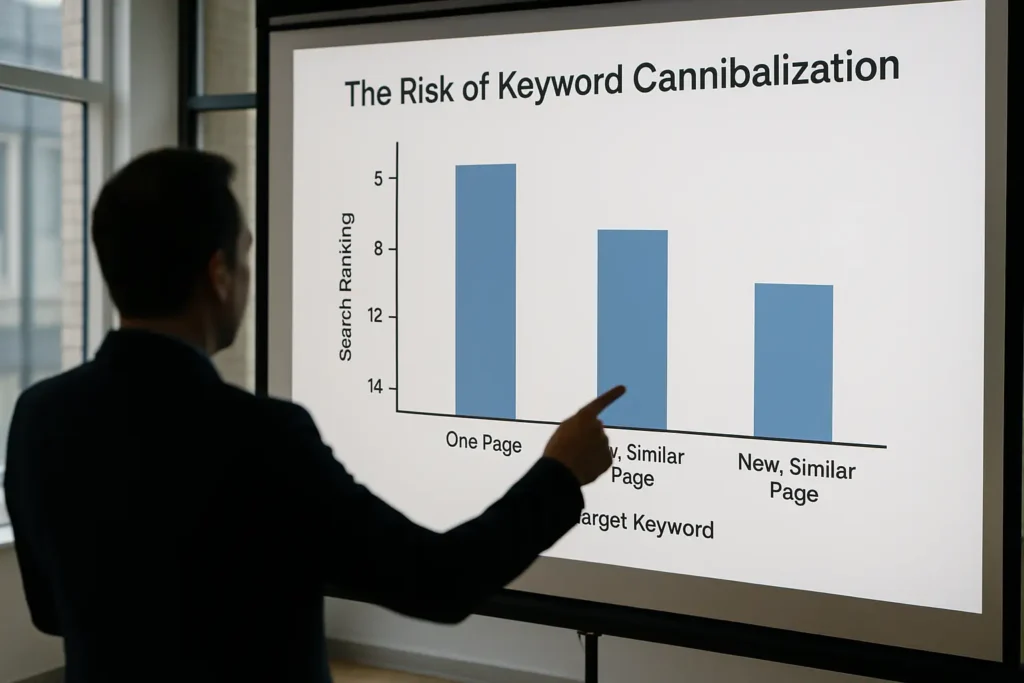
Look, we’ve been managing content clusters for years now, and there are two problems that appear every single time. Keyword cannibalisation (your pages start competing with each other instead of working together) and outdated content (that goes stale faster than office coffee left on the counter overnight).

How to Handle Common Content Cluster Challenges

Once you’ve seen these issues enough times, they become pretty predictable. You’ll spot them coming from a mile away.

Let us walk you through what we’ve learnt about catching these problems before they ruin your rankings.

Avoiding Keyword Cannibalisation

Imagine you’ve written three different pages about similar topics, and instead of backing each other, they’re having a wrestling match in Google’s search results. None of them win because Google can’t figure out which one deserves a front position.

Trust us, watching your own content sabotage itself is one of the most frustrating things you’ll experience in SEO.

Here’s how you can prevent this problem from happening in the first place:

  1. Map out your keywords before you start writing. This gives you a clear picture of what ground each page should cover.
  2. Give each page its own distinct focus and search intent. It means you’re thinking carefully about what specific question or need each piece addresses.
  3. Use specific angles for cluster pages rather than broad topics.

For example, if your pillar page covers “email marketing basics”, create cluster pages like “email subject line best practices” rather than “email marketing fundamentals”. That way, each page has its territory to dominate.

Auditing and Updating Cluster Content

Your content clusters require ongoing maintenance to stay effective, and honestly, this is where many people drop the ball. Search trends change, new information shows up, and your audience needs the latest update.

So what happens when you neglect this situation? Your outdated content signals to Google that you might not be the current authority on your topic anymore.

Keep your content fresh with these steps:

  1. Schedule regular checkups every six months. Treat it like a routine health exam for your content.
  2. Look for outdated statistics and broken internal links.
  3. Identify gaps where new cluster pages might strengthen your coverage.
  4. Update existing content with new data and insights.

Here’s a warning, though, and this one caught us off guard: don’t go overboard with updates. We had a client who got so enthusiastic about keeping things fresh that they were tweaking pages every few weeks. Their rankings started dropping.

Turns out Google interprets constant changes as instability rather than freshness. So, update your content when it’s needed instead of tweaking just for the sake of tweaking.

How to Measure the Impact of Your Content Clusters

You can measure your content cluster performance by tracking specific metrics to find its search visibility and business impact. The thing is, people get excited about building content clusters, spend weeks developing this beautiful web of interconnected articles, then sit back and… hope for the best.

It’s like planting a garden and never checking if anything’s growing at all.

We’ve been there. You pour your heart into creating these elaborate content structures, and three months later you’re squinting at Google Analytics wondering if any of it made an impact. The silence from your data dashboard can be deafening.

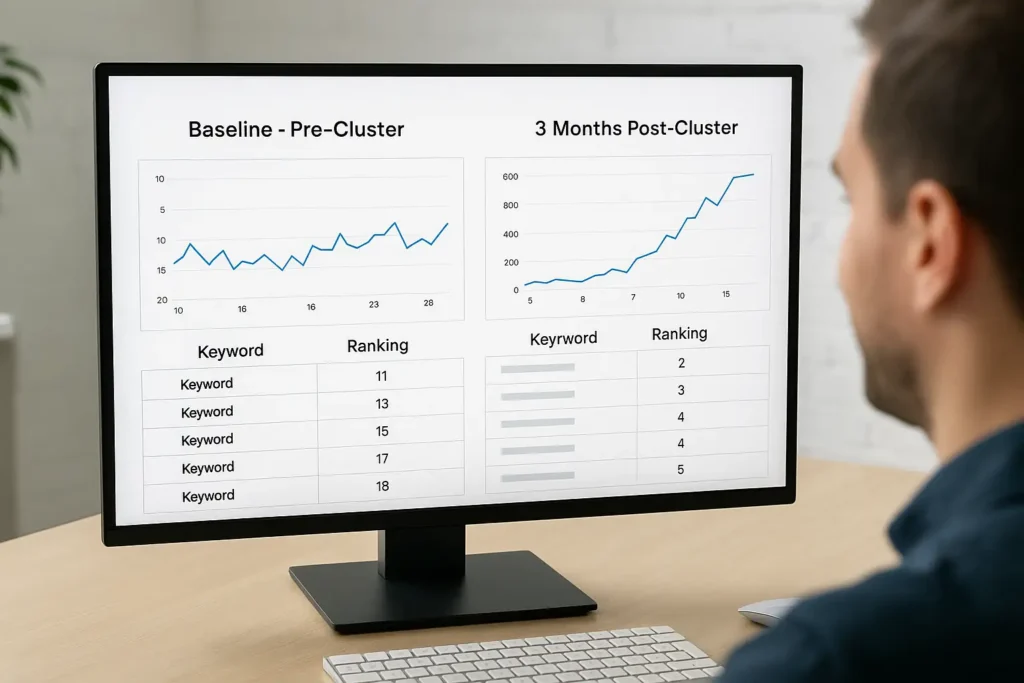
The solution is knowing what to measure before you even start writing. It’s similar to setting up a fitness tracker before you begin a workout routine. You need those baseline numbers, or you’ll never know if you’re making progress or just spinning your wheels.

So, start by establishing baseline measurements before implementing your clusters. And make sure to monitor changes monthly across traffic, rankings, and engagement patterns.

How to Measure the Impact of Your Content Clusters

We’ll explain now which numbers to watch and how they connect to your overall marketing goals.

Key Performance Indicators (KPIs) to Track

Your content cluster’s success comes down to specific, measurable outcomes directly impacting your business. In our experience, these metrics give you the clearest picture of cluster performance (they’re surprisingly revealing once you start paying attention):

  1. Organic Traffic Growth: Keep an eye on increases to both pillar and cluster pages compared to your baseline. For instance, if your pillar page was getting 500 visits monthly, look for steady growth to 800+ visits within six months.
  2. Keyword Ranking Improvements: Your target terms and related searches deserve close attention here. Your “email marketing” pillar might jump from page 3 to page 1, while cluster pages start ranking for terms like “email automation tools”.
  3. Internal Link Click-Through Rates: Measure how often visitors move between pillar and cluster content. A healthy cluster sees 15-25% of pillar page visitors clicking through to related articles.
  4. Time on Page and Bounce Rates: Engagement quality for your cluster content shows up in these numbers. Well-connected clusters typically show 3+ minute average sessions and bounce rates below 60%.
  5. Lead Generation and Conversions: Count actual business results from cluster pages. Track contact form submissions, newsletter signups, or consultation requests originating from your cluster content.
  6. Search Visibility Expansion: Sometimes Google surprises you with rankings on topic-related keywords you didn’t specifically target. For example, your content marketing cluster might suddenly rank for “blog writing tips” without you trying.
  7. Page Authority Improvements: Use tools like Ahrefs or SEMrush to measure domain strength changes. Look for your cluster pages gaining backlinks and authority scores over time.

Check these numbers monthly to identify trends early, because these emerging patterns can guide your entire content strategy.

Start Building Your Content Authority Today

Traditional SEO approaches leave many businesses struggling with poor rankings and scattered articles. Content clusters solve these problems by creating interconnected expertise hubs that Google recognises and rewards with better visibility.

In this article, we’ve shown you how to recognise pillar topics, research cluster keywords, implement strategic internal linking, avoid common errors, and measure your success effectively through proven metrics.

Stop letting your competitors dominate your industry’s search results. Contact our Brisbane SEO experts today and explore how we can build content clusters that establish your business as the trusted authority customers seek.

Technical SEO Basics Every Marketer Should Know

Ever launched a great-looking website, only to find that it barely shows up in search results? Chances are that it’s a technical SEO problem.

Many marketers focus on content and keywords. But the real foundations are crawlability, indexing, and site structure. If search engines can’t crawl or understand your site properly, all your content work might go to waste.

We’ll break down technical SEO for you in plain language. You’ll learn practical steps to help search engines find your site, get your pages indexed, and avoid common mistakes that slow you down. These technical SEO tips are clear and beginner-friendly.

Ready to learn how to get your site the attention it deserves? Let’s get started.

Crawlability: A Core Element of Technical SEO

Let’s start with understanding crawlability. It’s a search engine’s ability to access and scan your site’s pages. If crawl bots like Googlebot can’t find or load your pages, those pages won’t show up in search results.

This foundational SEO concept will help you ensure search engines find and index your content.

What Crawlability Means

Think of your website like a hotel. Crawlability is how easily a guest, like Googlebot, can walk through halls and open doors. If paths are broken or locked, your best rooms stay hidden (do you like it if you can’t find your hotel room easily? We certainly don’t).

Clean internal linking and logical directory paths are important for effective crawlability.

How Googlebot Visits Your Website

Search engines follow links to explore content. If you have broken links, hidden in scripts, or buried too deep in menus, they might get skipped.

Always make sure your main pages are linked prominently and follow a sensible structure.

Avoiding Mistakes in Your Robots.txt File

Your robots.txt file controls what bots can access on your site. It’s a powerful file, but you can easily misconfigure it and accidentally block important content from search engines.

When in doubt, keep your robots.txt simple, and check regularly what you’re restricting.

Why You Need an XML Sitemap

Your XML sitemap is a file that tells search engines which pages on your site you want them to index. It helps bots find your deeper content and improves crawl efficiency, especially if you have a new or large site.

Keep it updated and submit it through Google Search Console.

Crawl Budget: Don’t Let Bots Waste Time

Crawl budget refers to how many pages Google will crawl from your site. Even if you have a small site, you can waste this budget on duplicate content, junk URLs, or unnecessary filters. This reduces how often Google crawls your important pages.

Pro Tip: Run a Screaming Frog crawl to see your site through a bot’s eyes. It reveals what is getting missed.

Crawlability issues can wreck a website, often without you even knowing. Fixing them can improve your rankings even without changing a single word of your content.

Indexing: Getting Found the Right Way

You’ve probably wondered why some of your pages aren’t showing up in search results although the bots have crawled them. Here’s the thing: getting crawled doesn’t guarantee your pages will appear in search.

Indexing: Getting Found the Right Way

Indexing is how search engines store and organise your content after crawling it. If your pages aren’t indexed, they won’t appear in search results. It’s one of the most important factors in technical SEO that often gets ignored.

Crawling vs Indexing: Main Differences

Search engines first crawl your pages, then decide if they should index those pages.

Here’s a simple comparison:

CrawlingIndexing
What it doesFinds pages via links or sitemapStores pages in the search engine
OutcomeThe page is discoveredPage can appear in search results
Tool to useCrawl Stats in Search ConsoleURL Inspection tool in GSC

Check If Your Pages Are Indexed

Use the URL Inspection Tool in Google Search Console to check your page’s index status.

You can also search directly in Google like this: site:yourdomain.com/page-url

If nothing shows up, your page isn’t indexed and needs attention.

Canonical Tags Prevent Duplicate Confusion

When your content appears at multiple URLs, search engines can get confused about which version to show. Canonical tags help you signal which version is the main one.

  • Add <link rel=”canonical” href=”preferred-url”> in the <head> tag
  • Always point to the version you want ranked

When Noindex Makes Sense

Some of your pages don’t need to appear in search results. But you can keep them accessible to visitors while preventing search engines from indexing them. That’s when you use the noindex tag.

You add this tag to pages to prevent them from showing in search results. However, it doesn’t stop search engines from crawling and accessing the content.

Good use cases for noindex include:

  • Blog tag and archive pages
  • Thin or outdated content
  • Internal search results pages

Add this to your page’s like this: <meta name=”robots” content=”noindex”> .

JavaScript Can Hide Important Content

If your site relies heavily on JavaScript, search engines might miss important content. This is common with frameworks like React or Vue.

As a solution:

  • Use server-side rendering when possible
  • Use tools like Rendertron or prerender.io for pages that depend on JavaScript

Pro Tip: Use the “View Crawled Page” option in Search Console’s URL Inspection Tool. It shows you exactly what Googlebot sees when it crawls your pages, so you can fix rendering issues before they hurt your rankings.

Once search engines have indexed your pages properly, you can focus on how they’re structured. That’s what we’ll explore in the next section.

Site Structure: Building for Both Bots and Humans

Your site structure is how your pages connect and flow throughout your website. A clean structure helps your visitors find what they need quickly and gives search engines a clear path to follow.

However, if your pages are buried or your links are inconsistent, your visibility drops and your rankings suffer. This is especially true if you have a content-heavy or e-commerce site.

Flat vs Deep Architecture: How Many Clicks is Too Many?

A flat structure keeps your main pages within two to three clicks of your homepage. In contrast, your pages sit too far down deep architecture. They can slow down indexing and leave your important content hidden.

Here’s how to optimise your site structure:

  • Group your pages under clear categories
  • Link your popular content higher up the chain
  • Use sitemaps and internal links to help bots reach your deeper pages when needed

Internal Linking Increases Visibility and Flow

Internal links guide users, signal relevance to search engines, and distribute authority across your site.

Site Structure: Building for Both Bots and Humans

Examples of effective linking patterns:

  • Blog posts linking to relevant service or product pages
  • Category pages linking to subcategories and featured content
  • Body text linking to helpful guides or FAQs

Good internal linking keeps users engaged and improves your crawl coverage.

Helpful Menu Tips for Users

Clarity beats creativity when it comes to your site’s menus. Here are five ways to keep your navigation menu user-friendly:

  1. Use common, recognisable labels (e.g., Home, Services, Contact)
  2. Keep it simple. Avoid more than one dropdown level
  3. Feature your most important pages in the top nav
  4. Make sure it works on all screen sizes
  5. Include a search bar if your site has more than 30 pages

Your site’s menu should feel easy for visitors instead of being a puzzle.

Breadcrumbs Improve Structure and Search Listings

Breadcrumbs show your users their path through your site and support crawl logic. They also help Google understand your page relationships.

Example: Home > Courses > SEO > Technical SEO

They add internal links and can even appear in search results with proper schema markup.

Smart URL Structure Improves Clarity

Your URLs should be easy to read and naturally include relevant terms. Avoid long strings, special characters, and unnecessary IDs in your URLs. Here are examples of good and bad URLs.

  • Good URL: example.com/seo-services/local-seo
  • Bad URL: example.com/cat?id=45&ref=xyz123

Clean URLs are easier for users to remember and more useful for bots, too.

Pro Tip: Before you build or redesign your site, sketch out the full structure on paper. Because if you plan ahead, it will save you hours of cleanup later.

Next, we’ll look at why performance and speed have such a big impact on your rankings and crawlability.

Speed & Performance: The Overlooked SEO Lever

Your site speed and performance directly influence how often your site gets crawled, how quickly it’s indexed, and how well it ranks. Search engines want to serve content that loads fast and works smoothly for users.

When your pages load slowly, they frustrate visitors and waste your crawl budget. It can reduce your chances of appearing in search results.

Why Speed Impacts Crawling and Indexing

Search engines assign a limited window to crawl each site. When your pages have long load times, bots spend that time waiting instead of accessing more of your content. This reduces how much of your site gets indexed.

These are the crawling and indexing issues that happen when your site loads slowly:

  • Bots may abandon slow-loading pages.
  • Pages deeper in the structure may get skipped.
  • Frequent delays can lower the overall crawl rate.

A faster site makes it easier for bots to do their job efficiently.

Core Web Vitals: What Search Engines Measure

Google uses Core Web Vitals to assess how your pages perform for real users. These metrics affect both rankings and user satisfaction.

Main performance indicators:

Improving these scores helps both bots and humans use your site more smoothly.

Optimise Files for Faster Load Times

Large images and bloated code are common culprits behind your slow website. Simple adjustments to your site can create noticeable improvements.

You can utilise these practical optimisation tips:

These changes reduce load times without affecting your site’s layout or design.

Technical SEO Tips: Use CDN and Caching to Improve Delivery

A CDN stores versions of your site on multiple servers around the world. Caching saves parts of your site locally for your return visitors.

Performance benefits:

  • Shorter load times for users in different regions
  • Fewer delays during peak traffic
  • Less strain on your main server

These tools offer a strong return for minimal setup effort.

Pro Tip: Use PageSpeed Insights or GTmetrix to test page performance before you go live. They show exactly where delays are happening.

Handling Modern Web Tech: JavaScript & Dynamic Content

JavaScript powers a large share of modern websites. Tools like React and Vue make your pages more responsive and dynamic. But they often interfere with how search engines crawl and index your content.

Handling Modern Web Tech: JavaScript & Dynamic Content

If bots can’t see what your users see, that content won’t rank. This is one of the most important aspects of your technical SEO strategy.

How JavaScript Frameworks Affect Indexing

If your site is built with JavaScript frameworks, it sometimes loads important content only after the page finishes rendering. Search engines might crawl the shell of your page but miss what loads afterwards.

If that late-loading content includes your main text or links, your pages may never make it into Google’s index.

Make JavaScript SEO-Friendly

Three common solutions work well with modern scripts:

  • Hydration: Your page loads as basic HTML first, then JavaScript kicks in to make it interactive and dynamic.
  • Server-side Rendering (SSR): The server builds the complete page before sending it to users, so everything’s ready immediately.
  • Pre-rendering: You generate static HTML versions of your pages ahead of time so search engines can easily read them.

Each approach improves your site’s crawlability and keeps your content visible in search.

Avoid Crawl Traps with Dynamic URLs

Your search filters and parameters can create multiple versions of the same page. These duplicates confuse crawlers and waste your crawl budget.

Use these techniques to prevent that:

  • Add canonical tags to point to the main version.
  • Set URL parameter rules in Google Search Console.
  • Avoid linking to filtered URLs directly in your main navigation menu.

Pro Tip: Use site:yourdomain.com in a Google search with parts of your content. If you’re missing results, it could mean Google is struggling to index those pages.

Strengthen Your SEO With a Solid Technical Foundation

Technical issues are usually the reason behind disappointing SEO results. We’ve covered how crawlability, indexing, structure, speed, and JavaScript all influence how search engines interact with your site. Handling these elements well supports every other part of your SEO strategy.

The technical SEO tips in this guide are designed to give you clarity and control over your site’s performance. Clean architecture, fast load times, and search-friendly rendering help your content get seen more often and by the right people.

If you’re ready to find what’s holding your site back, we’re here to help. At Motifo, we take a practical, honest approach to SEO. No gimmicks, no false promises. Just smart fixes and measurable results.

Get in touch for a strategy session and start building a stronger SEO foundation today.

Proven Strategies to Boost Your Website’s Search Rankings

Search Engine Optimization (SEO) can make or break a website’s success. It doesn’t matter whether you’re just starting with your dream business venture or if you’ve been running an established website for years now; either way, SEO should be a priority for any website owner looking to increase their visibility online and acquire more customers. That said, many people don’t know how to go about properly optimizing their site and improving its search engine rankings – a clear roadblock to the success of your digital presence and all the possibilities that come along with it. Don’t worry though, as this blog post aims to help! Here are some proven strategies you can use today to boost your website’s search engine rankings!

Utilise SEO-friendly URL structures for your website pages

When it comes to building a website, there are many important factors to consider. One of these is the structure of your URLs. Making them SEO-friendly can greatly enhance your website’s visibility on search engines and help attract more traffic. By implementing meaningful keywords into your URL structure, you can optimize the page’s relevance and improve its chances of ranking higher in search results. Not only does this benefit your website’s visibility, but it also makes navigating your site easier for users. In today’s digital world, having a website with strong SEO practices is essential for success.

Research and use targeted keywords throughout the content on your website

In today’s digital age, having a website is crucial to establishing a strong online presence for your brand or business. But simply having a website isn’t enough – you need to make sure that potential customers can find it easily. That’s where targeted keywords come in. By researching the specific keywords that your audience is searching for, you can strategically place them throughout your website’s content to improve your ranking in search results. But it’s important to use them naturally and not overstuff your content, as this can hurt your ranking. So, take the time to do your research and incorporate those keywords in a way that feels organic and helps to boost your online visibility.

Optimize page titles and meta descriptions for better visibility in search results

In a world where the internet reigns supreme, having a strong online presence is essential for any business or individual hoping to succeed. One crucial aspect of a strong online presence is ensuring that your website appears at the top of search engine results when people search for keywords related to your content. One way to achieve this is by optimizing your page titles and meta descriptions – the summaries that appear under your page title in search results. By crafting clear, concise, and compelling titles and descriptions that accurately convey the content of your page, you can improve your website’s visibility and attract more traffic. It may seem like a small detail, but polishing your page titles and meta descriptions can make a big difference in the digital marketplace.

Increase site speed with image optimization and caching techniques

In our world, site speed has become one of the most crucial factors for online success. Slow-loading pages can cause users to quickly lose interest and turn to competitors for a faster experience. Fortunately, there are two effective ways to improve site speed: image optimization and caching techniques. By optimizing images, you can reduce their file size without compromising quality, allowing pages to load faster. Caching, on the other hand, saves a static version of your website, enabling it to load quickly without accessing the server every time. By implementing these simple yet powerful methods, your site can offer a faster, more enjoyable experience for visitors, setting you up for online success.

Utilise internal links to keep users engaged and direct traffic to other pages within your website

Internal links can be a powerful tool in keeping users engaged on your website. By directing them to other pages within your site, you can encourage them to explore more of what you have to offer. This not only increases the amount of time they spend on your site, but it also improves the chances that they’ll find what they’re looking for. Plus, internal linking can help with website navigation and improve the user experience. By creating a connected network of pages within your site, you can build a sense of coherence and structure that makes it easy for users to find their way around. Whether you’re directing traffic to your blog, product pages, or other important areas of your site, internal links can be a great way to keep users engaged and informed.

Create quality content that is relevant to your target audience

In today’s fast-paced digital age, creating quality content that resonates with your target audience has become more important than ever before. To build a successful brand, it’s vital to tailor your messaging so that it speaks directly to the needs and interests of the people you’re trying to reach. Whether you’re crafting a blog post, designing a social media campaign, or producing a video, your aim should be to provide value and establish a meaningful connection with your audience. By taking the time to understand their preferences and pain points, you can create content that not only informs but also entertains and inspires. Remember, quality content is not only about the message itself, it’s also about how effectively you communicate it to your audience. By striving to produce content that is engaging, informative, and relevant, you can build a loyal following and establish yourself as a trusted authority in your industry.

In short, creating an SEO-friendly website is essential for driving organic traffic to your business. The tips outlined above can help you do so in the most effective way, allowing your target audience to easily find and engage with you. Remember that SEO isn’t an overnight fix—it takes consistent effort over some time to see your website reach its full potential. However, if done right, the long-term rewards are invaluable! With that in mind, start optimizing and you’ll soon see greater visibility across search engines. Good luck!

The Ultimate Guide to Mastering SEO: Tips and Tricks

Are you looking for the inside scoop on mastering SEO? You have come to the right place! This comprehensive guide provides essential tips and tricks to help you effectively optimize your website, catch up with industry standards, and stay ahead of competition. By taking advantage of best practices in keyword research, copywriting, and site structure — among other techniques — you can get your webpages ranked higher in search engine results pages (SERPs) and gain more organic traffic. Keep reading to learn all about achieving success through SEO proficiency!

Understand the basics of SEO and how it works

In the digital world, understanding the basics of SEO can make all the difference when it comes to driving traffic to your website or online content. SEO, or search engine optimization, involves optimizing your website to rank higher in search engine results pages, making it easier for people to find you online. By using keywords, backlinks, and other optimization techniques, you can increase your visibility and attract more visitors to your website. But don’t be intimidated if you’re new to SEO – with some fundamental knowledge and a bit of effort, you can master the basics and start reaping the benefits.

Learn to use keywords to optimize your content

In today’s world, where almost everything is digital, having an online presence is essential. Whether you’re a blogger or a business owner, optimizing your website using keywords can help you stand out and attract more traffic. Keywords are the words and phrases that people use to search for something on the internet, and by incorporating them into your content, you increase your chances of being found. With the right keywords, your content can appear at the top of search engines, which means more visibility and more clicks. Learning to use keywords effectively is a valuable skill to have, one that can help you gain an advantage over others in your field. So, don’t wait any longer, start learning how to use keywords and start optimizing your content today!

Research keywords related to your industry and find out which ones are most effective

In today’s digital age, it’s important for every industry to have a strong online presence, and keywords play a vital role in that. As you research the different keywords related to your industry, you’ll discover that some are more effective than others in driving traffic to your website. By analyzing the data, you can narrow down which words and phrases your target audience is using to search for products or services within your industry. Armed with this information, you can create content that is not only relevant and engaging but also optimized for search engines, ultimately increasing your online visibility and attracting more potential customers. So, don’t underestimate the power of effective keywords and start exploring which ones can take your online presence to the next level.

Write quality content that is optimized for search engines

In today’s digital age, creating quality content that is optimized for search engines is essential for businesses and organizations to stand out in the online world. It’s not enough to simply write great content anymore – you also need to make sure that it can be easily found by search engines like Google. By conducting keyword research and incorporating those phrases into your content, you can increase your chances of ranking higher in search engine results pages (SERPs) and driving more traffic to your website. But it’s important to balance optimization with readability and engagement – after all, people are the ones reading your content. So whether you’re writing blog posts, website copy, or social media updates, focus on creating valuable and informative content that both readers and search engines will love.

Use images, videos, and other multimedia content to increase engagement

In today’s digital age, having multimedia content such as images and videos can greatly enhance engagement with your audience. Not only are they visually appealing, but they also provide a different way of conveying information compared to solely written content. Adding a relevant image or video can also catch the attention of those scrolling through social media or browsing your website, encouraging them to stop and read more. This type of content can help to make your message more memorable and shareable, increasing your reach even further. So, if you’re looking for ways to revamp your content strategy and boost engagement, consider incorporating multimedia elements into your next post or webpage.

Monitor your website analytics to understand what works and what doesn’t

In today’s digital age, having a website is crucial for businesses to thrive. However, it’s not just enough to have one; you need to monitor its analytics regularly. Not doing so can leave you in the dark about how your website is doing and what’s working or not. By tracking your website analytics, you can gather valuable insights that can help you make informed decisions to improve your website. You can figure out which pages are popular with your audience and which ones need improvement. You can also track your website’s traffic, bounce rate, and conversion rates, among other metrics, to see how your website is performing overall. In essence, monitoring your website analytics gives you the necessary data to make strategic changes to your website, ensuring that it works optimally, and brings you the results you desire.

SEO is a powerful tool that every business should be leveraging to increase their website’s visibility and rankings on the search engine. Learning the basics of SEO is an important aspect of creating a successful online presence. Understanding how it works, researching keywords related to your industry, creating quality content optimized for search engines, using images and videos, and continuously measuring website analytics will help you properly optimize your website for SEO. Businesses need to stay on top of their SEO game by always including up-to-date information and regularly monitoring analytics so that they can grow and succeed. By doing so, businesses will be able to achieve greater visibility on the web which in turn leads to higher rankings in searches.